Watch it move.
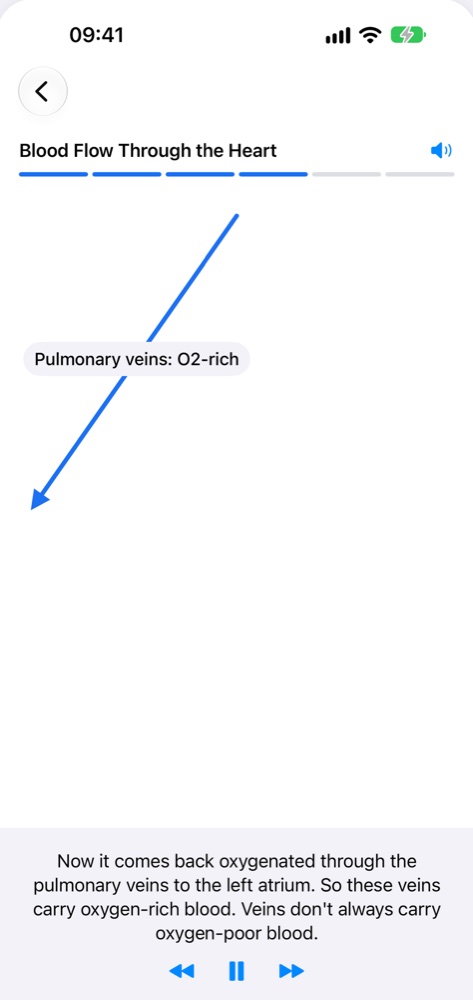
Short animated lessons across anatomy and physiology, biology and chemistry, with narration you can turn off.
 Sciwise
Get the app
Science is the section most students say is hardest. Watch the concept move, then answer TEAS-style questions that explain every wrong choice.
First lesson free. iPhone only. Or try one lesson here, no sign-up.
Analogy · pick what you're into
Analogy
Blood runs the same play every time. The right atrium takes the inbound pass: blood from the body, low in oxygen. It passes to the right ventricle, which shoots it to the lungs. The lungs reload it with oxygen. It comes back to the left atrium, which passes to the left ventricle, your strongest player, and the left ventricle launches it to the whole body through the aorta. Valves work like the backcourt rule: once the ball crosses, it can't go back.
Think of a kitchen with two lines. On the right line, used plates come back from the dining room (blood from the body, low in oxygen) into the right atrium, then the right ventricle sends them to the dish station (the lungs) to get cleaned and reloaded with oxygen. Clean plates come back to the left line: left atrium, then the left ventricle, the busiest cook, who sends them out to every table through the aorta. Valves are swinging doors that only open one way.
It's a two-lap circuit. Lap one: blood low in oxygen spawns in the right atrium, moves to the right ventricle, and gets sent to the lungs to recharge its oxygen. Lap two: it respawns in the left atrium, moves to the left ventricle, the strongest pump, and gets launched through the aorta to the whole map. Valves are one-way gates: no going back to the last checkpoint.
Where the analogy breaks: in a real heart, both atria squeeze at the same time, then both ventricles squeeze at the same time. The two sides work together, not one after the other.
Fact source: NIH National Heart, Lung, and Blood Institute, "How the Heart Works".
Lesson · Human anatomy & physiology
Step 0 of 7
It takes 7 steps to go from the body, through the lungs, and back out to the body.
Valve order: "Try Pulling My Aorta" = Tricuspid, Pulmonary, Mitral, Aortic.
Question 1 of 5
Written and checked by hand. Reference: NIH NHLBI, How Blood Flows through the Heart.
How it works
Question banks test you before you understand. Sciwise shows you how it works, then checks you, then keeps you on pace to your test date.
Short animated lessons across anatomy and physiology, biology and chemistry, with narration you can turn off.
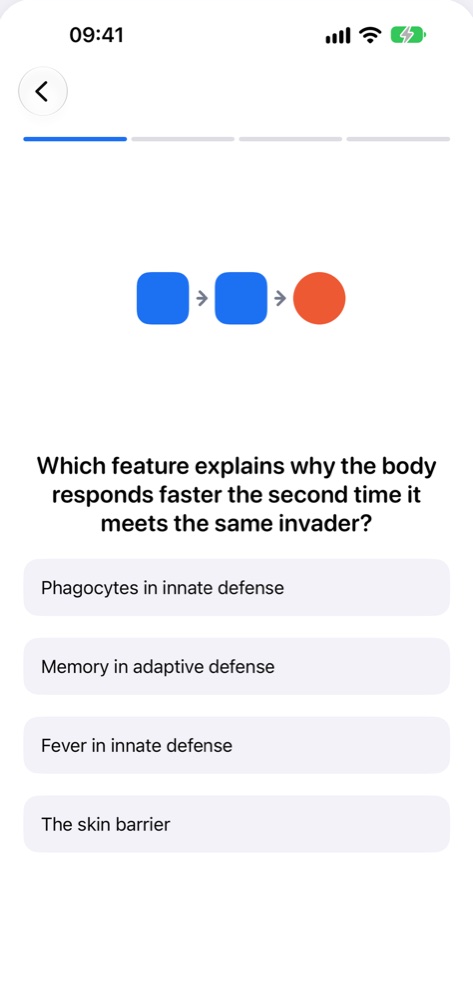
TEAS-style questions after every lesson. Pick wrong, and you see why that choice is wrong, not just the right answer.
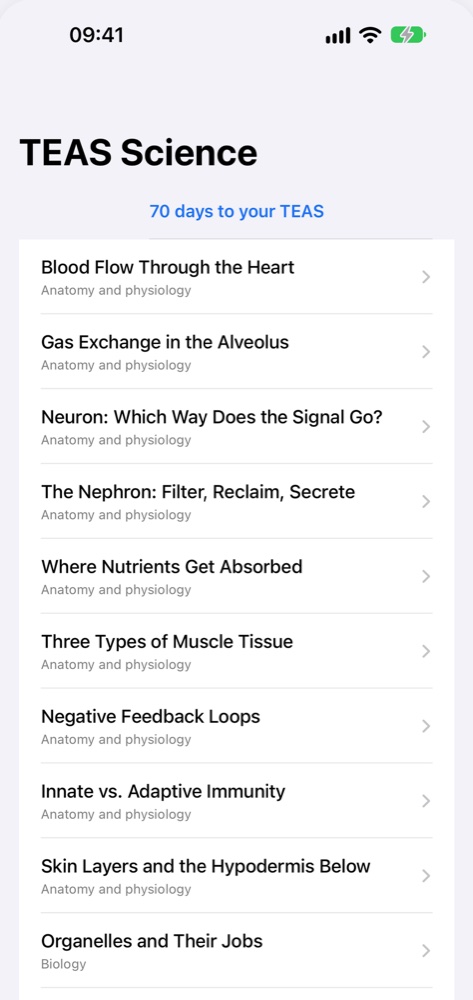
Set your test date and the app counts the days, so you always know what to study next.
Yes. Sciwise is an iPhone app for the science section of the TEAS 7. Each topic starts with a short animated lesson, then TEAS-style practice questions explain every wrong choice.
The TEAS 7 science section covers human anatomy and physiology, biology, chemistry and scientific reasoning. Sciwise lessons cover anatomy and physiology, biology and chemistry.
Understand the concept first, then practice. Science questions test how a process works, so learning it visually before answering questions sticks better than memorizing answers from a question bank.
No. TEAS and ATI TEAS are registered trademarks of Assessment Technologies Institute, LLC. Sciwise is not affiliated with or endorsed by ATI, and its practice questions are original.
Your first lesson is free: watch the concept move, then answer TEAS-style questions that explain every wrong choice.
Download on the App StoreiPhone only. Privacy